
Transit retirees fall behind inflation every year. In some years, it’s by a little, and in some years, it’s by a lot. The reason for this incremental erosion is the formula used to determine the annual cost of living adjustment (COLA) in the New York City Retirement System, NYCERS and the MABSTOA pension plans.
WHY ARE WE FALLING BEHIND?
The NYCERS and MABSTOA pension COLA increase is calculated as 50% of the previous year’s Consumer Price Index (CPI), with a minimum of 1% and a maximum of 3%, no matter how high the CPI goes. Also, the COLA is applied only to the first $18,000 of our annual benefit, which is another hit to the pension’s value. Because of the $18,000 rule, the COLA increase is never compounded from the previous year.
In the past ten years, the CPI has gone up 31 percent, but transit retirees have received only 15.3 percent, and again, applied only to the first $18,000 of the benefit.
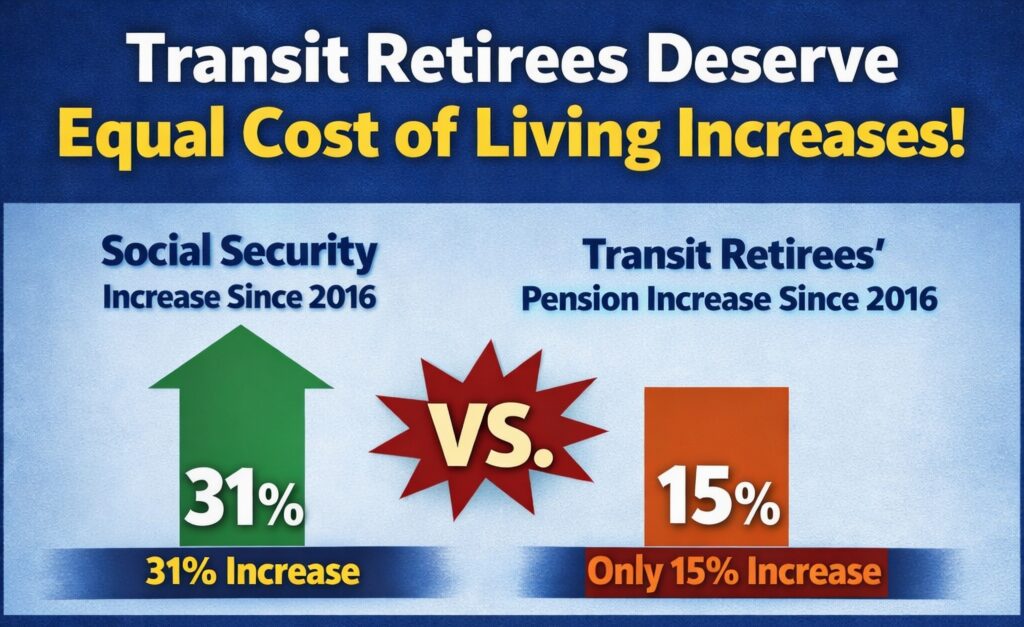
By comparison, Social Security provides the entire amount of the CPI as a COLA, and it is applied to the entire benefit, compounded each year. In other words, if the CPI is 5 percent, Social Security grants a 5 percent increase to the entire benefit.
That is what the TWU Local 100 Retirees Association wants for transit pensions. But the only way to change the COLA, or any pension related improvements, is through legislation in Albany.
James Whalen, Director of the Retirees Association, said “we have been advocating for this change for a long time. We are happy that the union is taking the first steps to get this done in Albany.”
WHAT IS THE LEGISLATIVE PROCESS?
The process for passing pension improvement legislation is not complicated, but it is time consuming, and it can take several legislative sessions to accomplish.
The first step is drafting of the bill itself and arranging for a sponsor or sponsors in both the Assembly and State Senate.
Because a pension improvement bill involves budgetary concerns, the bill needs what is call a “Fiscal Note,” or fiscal impact statement. A fiscal note must be requested by the
sponsor of the bill or by the chair of the committee to which the bill is referred.
For this particular bill, three fiscal notes could be required; one for NYCERS, one for the MABSTOA pension plan, and possibly one for the MTA which funds the plans, along with workers’ contributions.
LOCAL 100 LOBBY DAY IS MARCH 25, 2026
Your Retirees Association leadership will be in Albany for Lobby Day. We will have a clearly marked table where retirees can muster so we can lobby key legislators as a group.
Let’s show Albany that retirees care deeply about this issue.